If you have ever searched for a patio umbrella you have probably run into two terms that sound similar but mean very different products: cantilever parasol and center pole parasol. They both shade outdoor space. They both rotate on most modern models. They both come in 2 to 4 meter diameters. And they both break if you put the wrong one in the wrong place.This guide gives you the working comparison we use when consulting with hospitality and residential buyers. It covers structure, shade geometry, wind behavior, aesthetics, and the practical question of which one you should specify for your project.
What Is a Cantilever Parasol?
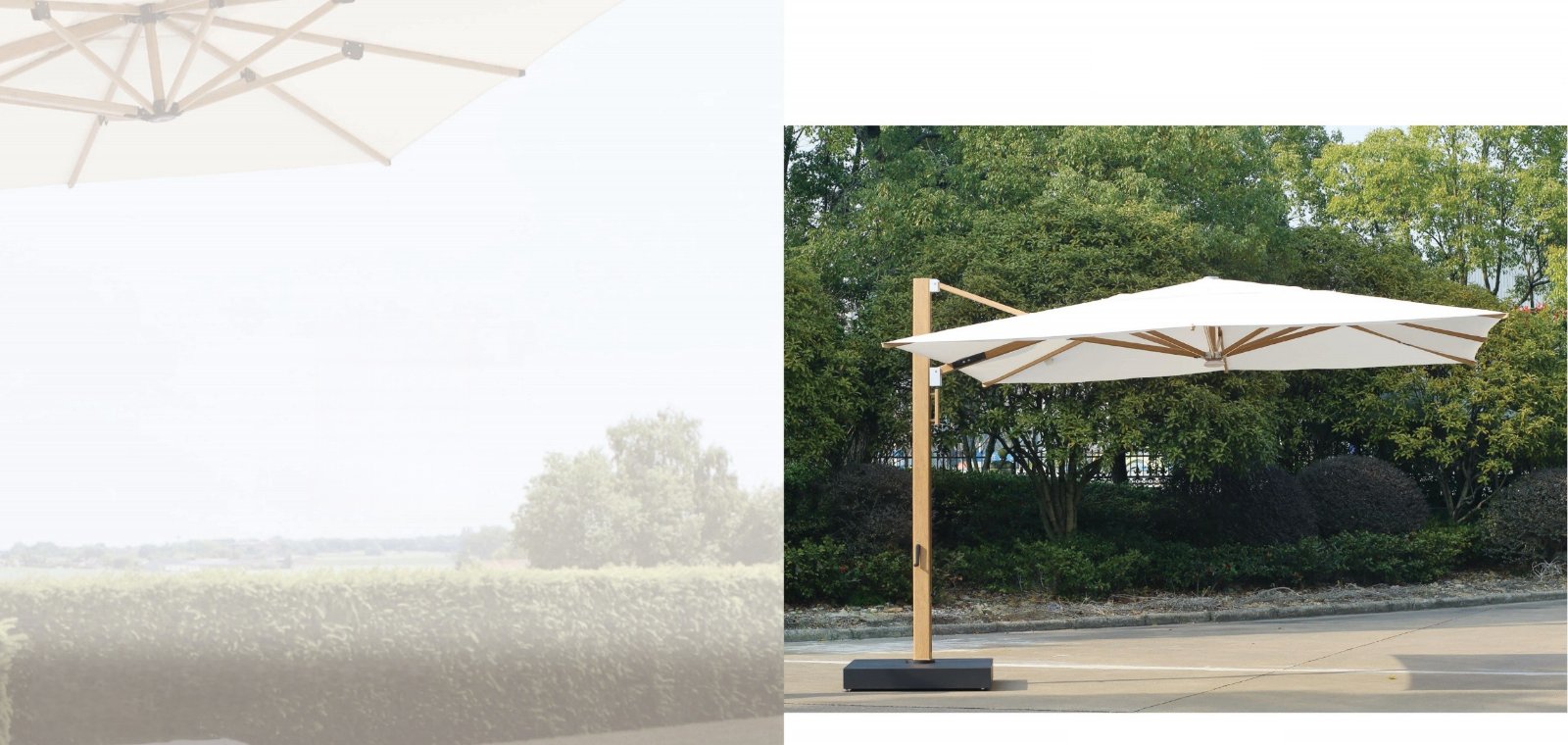
A cantilever parasol (also called offset or side-post umbrella) has its central support pole mounted to one side of the canopy, not under it. The canopy hangs out from the support like a swung arm, leaving the area directly underneath the canopy completely free of any obstruction. The result: a single pole in the corner or against a wall, full shade over a dining or lounging zone, no central post to navigate around.
The cantilever mechanism is more complex than a center pole. Most quality cantilever parasols use an aluminum backbone, gas-piston or manual lift, and a 360° rotating head. Some models (like our Aloha and Breeze lines) include a foot-pedal tilt and crank that you operate without touching the canopy.
Cantilever parasols are typically larger than center pole — popular sizes are 3×3m square, 3.5m round, and 4×4m square. The free-span design makes them ideal for shading large dining tables or two-piece lounge sets that would be impossible to fit under a center pole without the pole landing on the table or chair.
What Is a Center Pole Parasol?
A center pole parasol (also called market parasol or pole umbrella) has its support post running up through the middle of the canopy. The pole is part of the structure that holds the canopy up. Classic models have a rope-pull or pulley lift; modern models use a crank handle.
Center pole parasols are simpler, lighter, and lower cost than cantilever of equivalent size. A 2.7m round or 2×2m square center pole parasol typically costs 30–50% less than a cantilever of similar dimensions. The trade-off: the pole occupies valuable real estate under the canopy, which means tables need a parasol hole in the center and chairs must be arranged around the pole.
Center pole parasols are the standard choice for tight spots — a small balcony table, a 2-person bistro set, or a hotel poolside lounger — where shade area needs are modest and budget matters.
Shade Coverage and Geometry Compared
Canopy diameter alone is misleading. A 3m center pole parasol provides less usable shade than a 3m cantilever because the center pole and ribs take up space in the middle of the shaded circle. Walk-through clearance below the canopy is about 1m diameter on a 3m center pole, versus essentially the entire shaded zone on a cantilever.
Practically: a 3m center pole shades about 6.5 m² of usable area. A 3×3m cantilever shades about 8–9 m² because the entire canopy footprint is usable. As the canopy grows, the cantilever advantage increases — a 4×4m cantilever shades more than 14 m², equivalent to a 4.3m center pole that would be unwieldy and unstable.
Cantilevers also allow the canopy to extend over rectangular dining tables that center pole cannot fully cover — the cantilever arm can be positioned to drop shade over an entire rectangular surface.
Wind Resistance and Stability
Wind is where center pole and cantilever diverge most. A center pole with a heavy base is fundamentally more wind-stable than a cantilever of equivalent mass because its center of gravity is below the canopy load.
Cantilevers compensate with four design strategies: heavy pedestal bases (typically 100–250 kg concrete or granite-filled), cross-shaped base plates, anchor bolts set into concrete slabs, and counterweighted cantilever arms. A well-engineered cantilever should fold down or open vents at 30–40 km/h wind; a poorly anchored one will tip.
For commercial and hospitality settings we always recommend cantilever parasols with engineered anchor bolting to concrete slabs, plus an automatic wind sensor that closes the canopy above 35 km/h. For residential use a heavy pedestal base (200+ kg) is sufficient for most climates; coastal or rooftop settings should always use anchor bolts.
Best Use Cases: When to Choose Each
Center pole parasol wins when: budget is tight (under $200), the table has a parasol hole, shade area is 6 m² or less, the location is sheltered from wind, or you need a lightweight, easily movable shade.
Cantilever parasol wins when: the dining table has no center hole, you want to shade a rectangular or L-shaped zone, the table seats 4 or more, you want unobstructed headroom under the canopy, or the project is commercial (hotel, restaurant, beach club) and aesthetics matter at a higher level.
For a typical residential deck project with a 6–8 seat dining table and no parasol hole, cantilever is almost always the right answer. For a small 2-seat bistro balcony, center pole is the right answer. For hotel pool or beach, cantilever with full engineering.
Side-by-Side Specification
<strong>Center pole, 2.7m round</strong>: polyester 180g/m² canopy, aluminum pole 38mm, 6 ribs, crank lift, with base 22kg. Wind rated 30 km/h. FOB Ningbo from $42 for 100+ units. Lead time 35 days.
<strong>Cantilever, 3×3m square</strong>: polyester 250g/m² canopy (or olefin 280g/m² upgrade), aluminum backbone 60×60mm profile, 8 ribs, gas-piston lift, 360° rotation. Base 200kg concrete sold separately $190. Wind rated 45 km/h. FOB Ningbo from $280 for 50+ units. Lead time 45 days.
How BETTER-LIVING Helps You Specify
BETTER-LIVING manufactures both cantilever and center pole parasol ranges from our Ningbo factory. We have shipped over 200,000 units to European and American outdoor living brands since 2007. Our range covers 2m bistro center pole to 4×4m heavy commercial cantilever, with optional olefin fabric upgrade for UV-sensitive climates.
Send us your project brief — deck dimension, table size, desired shade area, wind exposure — and we will return a tailored spec with 3D layout, fabric swatches, and unit pricing within two business days. Email [email protected] or fill out the contact form on this site.
Case Study: 120-Room Beach Resort, Cyprus
A 120-room beach resort in Cyprus needed to shade 80 poolside lounger pairs plus 24 outdoor dining tables for the 2024 summer season. The brief: high UV exposure (UV index 11 in July), 35–40 km/h coastal winds in afternoon, six-month operating season with no seasonal tear-down.
We specified 24 cantilever parasols (3.5m round olefin) for the dining terrace and 80 cantilever parasols (3×3m square olefin) for the pool deck, all anchored with engineered bolt-down plates into the existing concrete deck. Four years later, with annual maintenance only (re-canvasing every 3 years), the original installation is still operating — total cost of ownership far below annual rental of temporary shades.
A center pole option would have been 35% cheaper upfront but required either drilling parasol holes in every dining table or accepting reduced shade geometry. The owner chose cantilever for the long-term aesthetic and operational simplicity.
Your Sourcing Checklist
- Measure the area you need to shade in square meters — subtract 10% for footprint of the cantilever pole base if applicable.
- Identify your table dimensions and seating count — a 4–6 seat rectangular table usually requires cantilever to shade fully.
- Estimate your typical wind speed — coastal or rooftop locations need engineered anchoring.
- Decide fabric upgrade: polyester 180g/m² for residential temperate, olefin 280g/m² for hot/high-UV climates.
- Specify base weight — minimum 4× canopy area in kg (3m cantilever needs 120+ kg base, 4m needs 200+ kg base).
- Plan for winter storage — cantilever frames can stay out but canopy should be removed in snow-prone climates.
Warnings to Watch For
- Do not anchor a cantilever to a wood deck without consulting a structural engineer — the lateral load can pull anchors out over time.
- Do not use lightweight plastic bases for commercial installations — they will fail in the first wind event.
- Do not assume the same fabric weight works for all climates — hot/high-UV climates need olefin; polyester fades within 2 seasons at UV index 9+.
Frequently Asked Questions
Center pole is intrinsically more stable for its weight because the support is centered. Cantilever relies on heavy bases or anchor bolts to compensate. With proper anchoring, both can reach 40–50 km/h wind ratings. Without anchoring, only center pole is reliable.
Yes — this is the cantilever’s primary advantage. A 3×3m cantilever parasol fully shades a rectangular 2×1m or 2.4×1.4m table without the pole obstructing seats. Choose the square canopy rather than round for this use case.
Center pole parasols install in 15–30 minutes with the base. Cantilever parasols typically take 1–2 hours including base assembly. Engineer-anchored commercial installs take 4–6 hours per unit.
Center pole parasol lead time is 30–40 days for 100+ units from our Ningbo factory. Cantilever parasol lead time is 40–55 days for 50+ units, including fabric production and aluminum extrusion.
Yes — both cantilever and center pole parasols can be ordered with solution-dyed olefin 280g/m² canvas, which provides 5–7 years of color fastness at UV index 11 versus 2–3 years for standard polyester 180g/m².