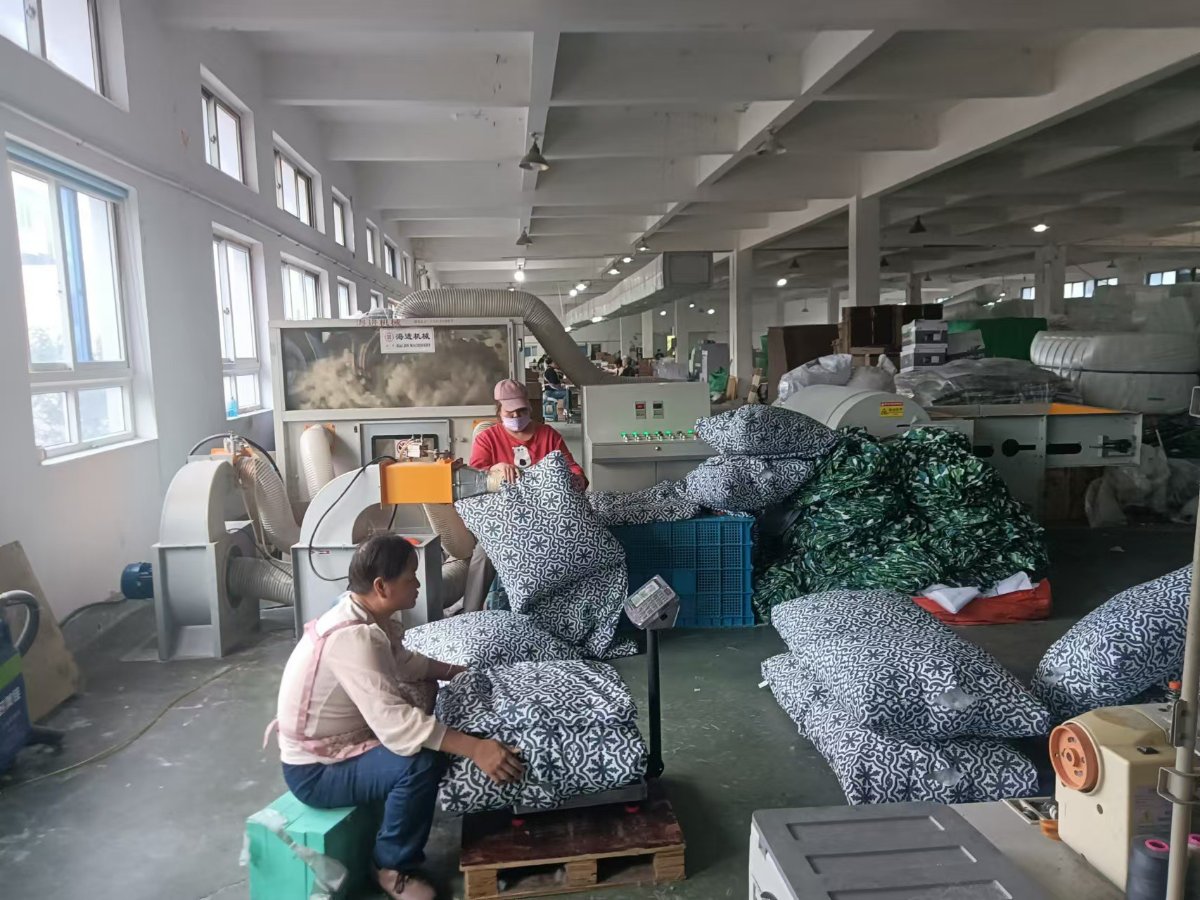
Outdoor products — parasols, cushions, garden furniture, shade sails — are one of the highest-potential sourcing categories from China. The country holds more than 60% of global outdoor furniture production capacity, and the engineering quality has matured dramatically over the last decade. But the gap between a working sample and a profitable shipping program remains wide. Most first-time importers lose money on their first or second order.This guide walks through the working playbook we recommend to our OEM/ODM clients. It is the same process our factory uses with European and American brands who scale from one trial container to 8–12 containers per year. If you follow this structure, your risk drops by an order of magnitude and your first order lands profitable rather than as a learning expense.
Step 1: Define Your Category and Unit Economics
Before contacting any factory, fix four numbers: target retail price, target landed cost, target MOQ, and target gross margin. These numbers determine which factories are even relevant.
If you want a $79 retail parasol, your landed cost must be under $30–$40 (target retail multiple of 2–3x). That means factory FOB price of $18–$25 for a basic 2.7m center pole. Many small workshops cannot hit that price; you need a 2,000–3,000 m² factory with extrusion lines in-house.
If you want a $329 retail cantilever parasol with olefin fabric, landed cost should be under $150, factory price $90–$110. This is a different factory tier entirely: aluminum tooling, gas-piston engineering, olefin fabric sourcing.
Cushions follow similar logic. A $49 retail dining chair cushion set requires factory FOB of $13–$18, requiring foam-cutting, sewing, and solution-dye fabric capacity in one facility.
Step 2: Selecting a Factory (and Filtering Out the Wrong Ones)
Once you have unit economics, list 8–12 candidate factories per category. The right starting pool depends on whether you want bespoke OEM (your design, their factory) or catalog ODM (their design, your label).
Vet each candidate on seven points: (1) business license and operating years, (2) factory footprint in square meters, (3) export license verification, (4) FIATA or industry association membership, (5) existing export customers you can call as references, (6) in-house processes for your specific category (fabric cutting, welding, foam, assembly, QC), (7) capacity utilization — a factory running at 80% capacity will give you priority over one running at 50%.
The fastest filter is a 30-minute video call with the factory sales lead: ask for a live walk-through of the facility, real-time production schedule, and three references. Any factory that refuses any of these is not ready for OEM export work.
Step 3: Sample Protocol and Approval
A formal sample process protects both sides. The wrong sample flow is: supplier sends a sample, importer approves, supplier produces 5,000 units, the produced units do not match the sample. The right flow is documented sample stages:
<strong>Pre-production sample (PPS)</strong>: made from production tooling, in production fabric, with full spec sheets. Cost $50–$300 per sample, paid by importer. Delivery 7–20 days. Should match the eventual production unit within acceptable variance.
<strong>Pre-shipment sample (PSS)</strong>: pulled from the first production run, after QC approval, shipped to importer. Free of charge usually. Used as final confirmation before container stuffing.
<strong>Reference sample kept at factory</strong>: signed and sealed, kept for the entire production run. Any dispute resolution reverts to this reference.
For outdoor products specifically, test the sample in your climate for at least 30 days — sunlight, rain, wind. Most quality failures appear in the second to fourth week of exposure, not in the first.
Step 4: MOQ, Pricing, and Payment Terms
MOQ in outdoor products is usually set by the fabric run, not the assembly line. For a custom-color polyester parasol canopy, the mill run is typically 500–1,000 meters of fabric per color, which sets MOQ at 200–500 parasols per color. For olefin, the mill run is shorter (200–500m) but the unit cost is higher.
Workarounds for MOQ: (1) order from factory’s standard color palette instead of custom Pantone, (2) combine multiple SKUs in one container to hit MOQ across the catalog rather than per SKU, (3) accept a 10–20% price premium for below-MOQ orders, (4) cooperate with another importer to share the fabric run.
Payment terms: standard is 30% T/T deposit on PO confirmation, 70% balance against B/L copy. Some long-term relationships can negotiate 20/80 or even L/C at sight. Never pay 100% upfront; never pay to a personal account.
Step 5: Quality Control During Production
Quality control has three checkpoints: (1) <strong>DUPRO</strong> (during production) inspection at 30–50% completion, (2) <strong>PSI</strong> (pre-shipment) inspection at 100% completion when 80%+ of the order is packed, (3) <strong>CLC</strong> (container loading check) to confirm packing, marking, and loading match the PO.
Hire an independent inspection company — we typically recommend SGS, Bureau Veritas, or HQTS for Asian buyers — to perform DUPRO and PSI. Cost is $250–$450 per inspector-day, with 1–2 days needed for parasol and cushion QC.
Common QC failures in outdoor products include: fabric color drift from approved sample, rib welding porosity, seam stitching density below spec, foam density below spec, missing hardware, missing labels and care tags, improper folding/packing causing canopy creases. A structured inspection catches these before container stuffing, not after delivery to your warehouse.
Step 6: Container Loading and Logistics
Parasols and cushions are bulky and light by nature, so container cube utilization is more often the constraint than weight. A 40HQ holds about 65 m² of usable space — typical 3m cantilever parasols fit 280–320 units per 40HQ, center pole parasols fit 700–1,000 units per 40HQ depending on canopy diameter.
Cushions are even more cube-driven: a 40HQ holds 3,500–6,000 dining chair cushion sets depending on foam density and packing. Polybag and master carton configuration is where most buyers overspend on cube — ask the factory for an optimized packing plan before the PSI.
For ocean freight, FOB Ningbo to Long Beach runs $2,200–$3,200 per 40HQ in 2026. Add $450 for U.S. destination port handling, $180 ISF, $250–$450 customs broker and entry filing, plus 25–60% of value for Section 301 duty depending on HTS code.
Step 7: Common Pitfalls First-Time Importers Hit
We have seen the same five mistakes lose first-time importers 6 to 12 months and tens of thousands of dollars:
1. <strong>Choosing on lowest quote</strong>. A $2 cheaper FOB price from an unlicensed workshop becomes a $30,000 loss when customs or QC fails.
2. <strong>Skipping DUPRO inspection</strong>. A 30% production check catches issues that would otherwise fill an entire container with defective goods.
3. <strong>No fabric specification</strong>. “Same as sample” without specifying yarn count, weight, UV rating, color fastness leads to fabric drift between sample and production.
4. <strong>Wrong HTS classification</strong>. Misclassifying cushions as “seat covers” instead of “upholstered furniture” can trigger an audit. Use a licensed customs broker.
5. <strong>No engineering documentation</strong>. In markets like the EU, the product must meet EN 581 (outdoor furniture) and EN 13537 (parasol safety). Factory must provide test reports.
Step 8: BETTER-LIVING's OEM/ODM Program
BETTER-LIVING operates as a one-stop OEM/ODM partner for outdoor parasols and cushions. Our Ningbo factory covers 22,000 m² with aluminum extrusion, fabric cutting, foam production, sewing, assembly, and final QC all under one roof.
Our standard OEM program: design consulting (color matching, structural engineering), PPS in 7–10 days, full production in 30–45 days from PO, CLC with photo report, freight coordination through our partner NVOCC for FOB or DDP at buyer’s option.
Send your design brief or pick from our 2026 catalog of 200+ parasol designs and 80+ cushion SKUs. We respond with samples, pricing, and tooling lead time within 48 hours.
Case Study: Brand A's First Container — What Worked
A small U.S. DTC brand (annual revenue $2M) wanted to launch a private-label 3×3m cantilever parasol in spring 2026. They followed our playbook for a single 40HQ trial order of 320 units at $92 FOB Ningbo.
Key wins: they specified all critical dimensions and fabrics in writing before PPS ($300 sample cost); used HQTS for DUPRO at 35% completion ($420) and PSI ($380) inspections; pre-arranged a U.S. CHB-licensed broker for the DDP entry and FBA prep at Long Beach.
Total all-in landed cost including freight, duty (Section 301 25%), entry, and FBA prep was $148/unit. Retail price $329. Gross margin 55%. The brand ordered six more containers in the following 10 months.
Your Sourcing Checklist
- Define target retail price and compute factory FOB price target (typically retail 3x of FOB).
- Verify factory business license, export license, and references before sending any design files.
- Order pre-production sample with full spec sheet; do not skip the climate aging test (30+ days in real sun).
- Set DUPRO inspection at 30% production completion; PSI before container stuffing.
- Negotiate payment terms 30/70 T/T minimum; do not accept 100% upfront or personal account payments.
- Confirm fabric run length matches your total SKU MOQ across colors; work around MOQ with multiple SKUs in one container.
- Arrange U.S. licensed customs broker before booking ocean freight to avoid duty delay penalties.
- Pre-confirm retailer/Amazon compliance: EN 581 in EU, EN 13537 for parasol safety, FCC for electronic components.
Warnings to Watch For
- Do not pay a factory 100% upfront before production — standard terms are 30/70 against B/L copy.
- Do not accept verbal confirmation of fabric specs — require a signed fabric specification sheet attached to the PO.
- Do not skip DUPRO — a $400 inspection saves $40,000 in defective cargo rejection.
- Do not assume the sample is identical to mass production without a fabric-spec sheet and mill certificate.
Frequently Asked Questions
For a custom Pantone-color canopy, MOQ is usually 200–500 units per color. For a stock-color canopy from the factory palette, MOQ drops to 50–100 units. Cushion MOQs are similar: 500 pieces per fabric-color combination standard.
From approved sample to container loaded, a typical outdoor product OEM cycle is 45–75 days: 30–40 days for mass production, 7–10 days for QC and container stuffing, 5–7 days for customs and FOB. Sample development adds 7–20 days before that.
Yes — most reputable factories accept below-MOQ orders with a 10–20% price surcharge, or you can combine multiple SKUs in one container to hit MOQ across the assortment. Sample orders of 50–100 units are often feasible at standard pricing for new clients willing to pay for the trial.
Ask for a live video walk-through showing production lines running during the call. Ask for factory photos dated within 30 days. Cross-check the business license factory address on Google Street View and Baidu Maps. Ask for a customer reference who has ordered within the last 90 days and can describe the actual production run.
Yes — BETTER-LIVING’s partner forwarder BY-LINE ships DDP from Ningbo to FBA warehouses. The DDP quote covers ocean freight, Section 301 duty, customs broker, FBA labeling, suffocation labels, poly bagging, and final-mile delivery with appointment scheduling.