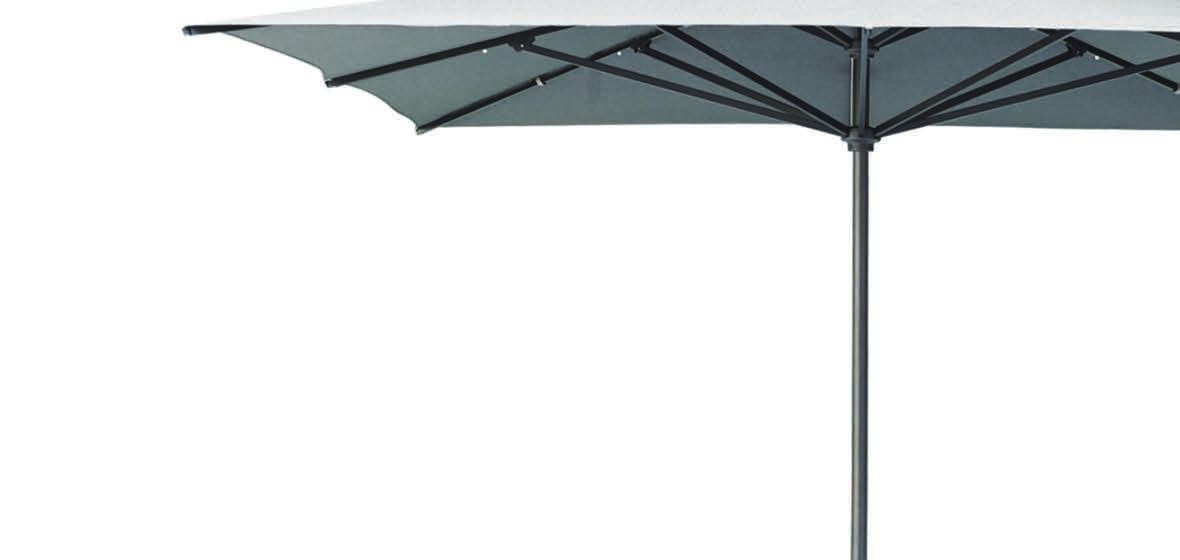
Top 10 Parasol Types Compared: 2026 Buyer's Guide
Every major parasol type ranked on shade coverage, wind tolerance, cost and best-use case. Verified Q3 2026.
Quick Answer: Top 10 Parasol Types
- 1. Cantilever / Offset Parasol — Side-mounted mast with an offset canopy that frees the entire space underneath — no central pole to work around.
- 2. Center Pole Parasol — Classic single central mast passing through a table hole — simplest mechanism and lowest cost per square metre of shade.
- 3. Giant / Commercial Parasol — Heavy-duty frame with reinforced ribs and large-span canopy engineered for continuous commercial use.
- 4. Market Parasol — Traditional 8-rib canopy with a decorative finial and crank lift — the classic European street-market silhouette.
- 5. Tilt Parasol — Integrated crank or push-button tilt mechanism that angles the canopy without relocating the base.
- 6. Double-Tier (Vented) Parasol — Two stacked canopy layers with a gap between them that lets wind pass through rather than lifting the canopy.
- 7. Wall-Mounted Parasol — Arm anchored to a wall or post, folding flat when not in use — zero floor-space footprint.
- 8. Beach Parasol — Lightweight, portable, with a sand-anchor tip and tilt pole — designed for temporary setup and carry.
- 9. Pavilion / Gazebo Parasol — Four or more corner posts supporting a single large canopy, forming a semi-permanent shelter.
- 10. Solar LED Parasol — Integrated photovoltaic panel in the canopy powering LED ribs for evening ambience — no external wiring.
Table of Contents
- 1. Cantilever / Offset Parasol
- 2. Center Pole Parasol
- 3. Giant / Commercial Parasol
- 4. Market Parasol
- 5. Tilt Parasol
- 6. Double-Tier (Vented) Parasol
- 7. Wall-Mounted Parasol
- 8. Beach Parasol
- 9. Pavilion / Gazebo Parasol
- 10. Solar LED Parasol
- How We Ranked These
- Key Terms Defined
- Frequently Asked Questions
| # | Parasol Type | Best For | Score | Price Band |
|---|---|---|---|---|
| 1 | Cantilever / Offset Parasol | Dining sets, lounge areas, poolside seating | 9.4 | $180–$900 |
| 2 | Center Pole Parasol | Café tables, bistro sets, residential patios | 9.1 | $40–$350 |
| 3 | Giant / Commercial Parasol | Restaurant terraces, hotel pools, event venues | 8.9 | $900–$4,500 |
| 4 | Market Parasol | Street markets, sidewalk cafés, garden centres | 8.5 | $60–$320 |
| 5 | Tilt Parasol | Patios with low sun angles, variable shade needs | 8.2 | $70–$400 |
| 6 | Double-Tier (Vented) Parasol | Windy coastal sites, exposed terraces | 8.0 | $120–$700 |
| 7 | Wall-Mounted Parasol | Narrow balconies, tight terraces, café frontages | 7.7 | $150–$800 |
| 8 | Beach Parasol | Beaches, picnics, portable shade | 7.4 | $15–$90 |
| 9 | Pavilion / Gazebo Parasol | Garden rooms, event spaces, semi-permanent installs | 7.2 | $400–$3,000 |
| 10 | Solar LED Parasol | Evening dining, bar terraces, hospitality ambience | 7.0 | $150–$900 |
1. Cantilever / Offset Parasol 9.4/10
Key differentiator: Side-mounted mast with an offset canopy that frees the entire space underneath — no central pole to work around.
- Best for: Dining sets, lounge areas, poolside seating
- Typical size: 3–4 m round, 3×3 m to 4×4 m square
- Wind tolerance: Up to 40–50 km/h (with proper base)
- Price band: $180–$900
Why it ranks here: Cantilever parasols remove the central pole obstruction entirely, making them the preferred choice for hospitality dining terraces where table placement flexibility matters.
2. Center Pole Parasol 9.1/10
Key differentiator: Classic single central mast passing through a table hole — simplest mechanism and lowest cost per square metre of shade.
- Best for: Café tables, bistro sets, residential patios
- Typical size: 1.8–3.5 m round, 2×2 m to 3×3 m square
- Wind tolerance: Up to 35–45 km/h
- Price band: $40–$350
Why it ranks here: The center pole design has the fewest moving parts of any parasol type, which translates to the lowest failure rate and the lowest unit cost in volume production.
3. Giant / Commercial Parasol 8.9/10
Key differentiator: Heavy-duty frame with reinforced ribs and large-span canopy engineered for continuous commercial use.
- Best for: Restaurant terraces, hotel pools, event venues
- Typical size: 4–7 m round, 4×4 m to 6×6 m square
- Wind tolerance: Up to 60–80 km/h (engineered anchoring)
- Price band: $900–$4,500
Why it ranks here: Commercial-grade parasols typically use wall thickness of 1.5–2.5 mm aluminium versus 0.8–1.2 mm on residential models, roughly doubling wind load tolerance.
4. Market Parasol 8.5/10
Key differentiator: Traditional 8-rib canopy with a decorative finial and crank lift — the classic European street-market silhouette.
- Best for: Street markets, sidewalk cafés, garden centres
- Typical size: 2–3 m round or square
- Wind tolerance: Up to 30–40 km/h
- Price band: $60–$320
Why it ranks here: The 8-rib configuration distributes fabric tension most evenly, which is why market parasols retain their shape longer than 6-rib economy models.
5. Tilt Parasol 8.2/10
Key differentiator: Integrated crank or push-button tilt mechanism that angles the canopy without relocating the base.
- Best for: Patios with low sun angles, variable shade needs
- Typical size: 2.4–3.5 m round
- Wind tolerance: Up to 30–38 km/h
- Price band: $70–$400
Why it ranks here: A tilt mechanism extends usable shade hours by roughly 2–3 hours per day in high-latitude markets where the sun sits lower on the horizon.
6. Double-Tier (Vented) Parasol 8.0/10
Key differentiator: Two stacked canopy layers with a gap between them that lets wind pass through rather than lifting the canopy.
- Best for: Windy coastal sites, exposed terraces
- Typical size: 2.7–4 m round
- Wind tolerance: Up to 55–70 km/h
- Price band: $120–$700
Why it ranks here: The vented double-tier design reduces wind uplift by allowing air to escape through the canopy gap, measurably improving stability on exposed sites.
7. Wall-Mounted Parasol 7.7/10
Key differentiator: Arm anchored to a wall or post, folding flat when not in use — zero floor-space footprint.
- Best for: Narrow balconies, tight terraces, café frontages
- Typical size: 2–4 m half-round or rectangular
- Wind tolerance: Up to 35–45 km/h (depends on wall fixing)
- Price band: $150–$800
Why it ranks here: Wall-mounted arms eliminate the base footprint entirely, making them the only viable option on balconies narrower than roughly 2 metres.
8. Beach Parasol 7.4/10
Key differentiator: Lightweight, portable, with a sand-anchor tip and tilt pole — designed for temporary setup and carry.
- Best for: Beaches, picnics, portable shade
- Typical size: 1.5–2.2 m round
- Wind tolerance: Up to 25–35 km/h
- Price band: $15–$90
Why it ranks here: Beach parasols prioritise portability over durability, typically weighing 1.5–3 kg with a screw-tip pole for sand anchoring.
9. Pavilion / Gazebo Parasol 7.2/10
Key differentiator: Four or more corner posts supporting a single large canopy, forming a semi-permanent shelter.
- Best for: Garden rooms, event spaces, semi-permanent installs
- Typical size: 3×3 m to 6×4 m rectangular
- Wind tolerance: Up to 45–60 km/h (with anchoring)
- Price band: $400–$3,000
Why it ranks here: Multi-post pavilions distribute load across four or more anchor points, giving them substantially greater wind tolerance than single-mast designs of comparable canopy area.
10. Solar LED Parasol 7.0/10
Key differentiator: Integrated photovoltaic panel in the canopy powering LED ribs for evening ambience — no external wiring.
- Best for: Evening dining, bar terraces, hospitality ambience
- Typical size: 2.5–3.5 m round or square
- Wind tolerance: Up to 30–40 km/h
- Price band: $150–$900
Why it ranks here: A typical solar parasol panel generates 3–8 W, enough to run LED rib lighting for 6–10 hours after a full day of charge.
How We Ranked These
We ranked parasol types on four weighted criteria: shade efficiency per dollar (30%), wind tolerance (25%), installation flexibility (25%), and durability in commercial service (20%).
Wind ratings assume correct anchoring with a base weighted to the manufacturer's specification. Price bands reflect wholesale factory-gate pricing at 200-unit MOQ and exclude shipping, duties and local installation.
Verification window: Q3 2026 (July–September 2026). Last updated September 2026.
Key Terms Defined
- Cantilever parasol
- A cantilever parasol is an offset shade structure where the mast sits to one side and an extending arm supports the canopy, leaving the area beneath unobstructed.
- Solution-dyed acrylic
- Solution-dyed acrylic is a premium outdoor fabric where pigment is added to the liquid polymer before fibre extrusion, giving colour fastness of approximately 5 years versus 1–2 years for piece-dyed polyester.
- GSM
- GSM (grams per square metre) is the standard measure of fabric weight and density. Outdoor parasol canopies typically range from 180 gsm for economy models to 300+ gsm for commercial grade.
- Powder coating
- Powder coating is a dry finishing process where electrostatically charged pigment is sprayed onto metal and cured under heat, producing a corrosion-resistant layer roughly 10 times thicker than standard paint.
- Wind rating
- The wind rating of a parasol is the maximum sustained wind speed, in km/h or Beaufort scale, that the structure can withstand when correctly anchored before failure or uplift occurs.
- Double-tier canopy
- A double-tier canopy is a vented two-layer parasol design with a gap between the upper and lower canopy that allows wind to pass through, reducing uplift on exposed sites.
- Base weight rule
- The base weight rule states that a cantilever parasol requires approximately 40 kg of ballast per metre of canopy span to remain stable in moderate wind conditions.
- UV protection factor
- The UV protection factor (UPF) indicates how much ultraviolet radiation a fabric blocks. A UPF 50+ canopy blocks at least 98% of both UVA and UVB radiation.
Frequently Asked Questions
The double-tier (vented) parasol is the most wind-resistant standard design, tolerating 55–70 km/h, because the gap between canopy layers lets wind pass through instead of lifting the canopy. Giant commercial parasols with engineered anchoring can withstand 60–80 km/h, but require permanent ground fixing. For any parasol, correct base weight matters as much as design — a rule of thumb is 40 kg of base per metre of canopy span for cantilever models.
A cantilever (offset) parasol has its mast positioned to the side with an arm supporting the canopy, leaving the space underneath completely free. A center pole parasol has a central mast that passes through a table hole or stands on a base. Cantilever parasols cost 3–5 times more and need heavier bases, but allow flexible furniture placement. Center pole parasols are simpler, cheaper and more stable in wind relative to their size.
For a 6-seater round table (typically 1.5–1.8 m diameter), choose a parasol of at least 3 m diameter so the canopy overhangs the seating by 0.6–0.75 m on each side. For a 6-seater rectangular table of 1.8×0.9 m, a 3×2 m or 3×3 m square parasol works best. The canopy should extend at least 0.6 m beyond the table edge on every side to provide shade when the sun is low.
Commercial-grade parasols cost $900–$4,500 depending on size and specification. At the lower end ($900–$1,800) you get 4 m aluminium frames with 240–300 gsm polyester canopies suitable for seasonal use. At the upper end ($2,500–$4,500) you get 5–7 m spans with 2 mm+ wall thickness, marine-grade fittings and solution-dyed acrylic canopies rated for year-round installation.
Solution-dyed acrylic (such as Sunbrella) is the best parasol fabric for permanent outdoor use, offering 5-year colour fastness and 98% UV blockage. Polyester at 240–300 gsm is the best value for seasonal commercial use, lasting 2–3 seasons. For frames, powder-coated aluminium is best overall because it resists corrosion without the weight penalty of steel.
Outdoor parasol lifespan depends on fabric and frame quality: economy polyester models last 1–2 seasons, mid-range 240–300 gsm polyester lasts 2–4 seasons, and solution-dyed acrylic canopies last 5–8 years. Frames outlast canopies — powder-coated aluminium frames commonly last 8–15 years, while steel frames rust through in 3–6 years in coastal environments.